"What are the treatment patterns for newly diagnosed Type 2 Diabetes patients aged 40–65 with commercial insurance?"
Research plan
Generating cohorts
Results ready
Results · 3 min 42 sec
Cohort size2.8M patients
First-line metformin67.3%
GLP-1 initiation18.9%
All-payer claims · Jan 2020–present
“
Why Medeloop
Built for healthcare from the ground up
Not cobbled together from disconnected tools.
Clinical Rigor
Validated at every step, from clinical code selection to statistical output. Built for the standards your reviewers expect.
AI That You Control
Human-in-the-loop at every step. Full audit trails, editable research plans, and transparent reasoning.
No Harmonization Required
Our semantic engine reads your data natively: no OMOP mapping, no CDM conversion, no months of prep.
Your Data, Your Rules
Compute goes to the data. Whether it's your EHR, claims, or registries, data never leaves your walls.
The Research Lifecycle
One loop. Endless evidence.
The only platform connecting funding, study management, analysis, and care delivery. Win the grant, run the study, analyze the data, improve the care, then fund the next one.
01 · Grants
Find funding. Write winning proposals.
02 · Analytics
From question to evidence in minutes.
03 · Care
From population insights to patient action.
Who We Serve
Research. Evidence. Action.
The same AI platform, configured for your workflow, your data, and your goals.
Pharma & Life Sciences
National-scale RWE on demand
For HEOR, clinical R&D, and biotech teams. Bring your own data or license our all-payer claims dataset. Either way, get publication-ready evidence without the overhead.
Treatment patterns & burden of disease
Comparative effectiveness at scale
Works on your data or ours: no CDM conversion required
For health systems, HCOs, and clinical researchers who need to publish, benchmark, and act on population insights, whether you're supplementing an existing analytics team or starting from scratch.
Publish faster with EvidenceKit
Benchmark your population against national claims data
AI-powered analytics that augments your existing team
Need data? EvidenceKit pairs the Analytics platform with all-payer claims data.
The agentic loop
Research question
Pending
Your clinical question is parsed, structured, and validated against available data sources and study design requirements.
Evaluate feasibility
Pending
The agent checks cohort size, data coverage, and statistical power to confirm the analysis can be completed reliably.
Research plan
Pending
A full protocol is generated: cohort definition, inclusion/exclusion criteria, outcome variables, and statistical methods.
Run analysis
Pending
Federated queries execute where your data lives. Outputs include cohorts, visualizations, and a publication-ready report.
How It Works
From question to evidence in five steps.
01
Ask
Submit your research question in plain English
02
Clarify
AI evaluates feasibility and clarifies study design
03
Plan
Protocol, cohort, and analysis plan — you review and edit
04
Execute
Validated code runs on your federated data
05
Deliver
Publication-ready outputs, figures, and audit trail
The Medeloop Flow
From question to a network of research outputs.
An agentic loop with human oversight at every step. Queries run on your data and execute in your environment or ours, depending on your preference.
Your Data
Stays in your infra
EHR / EMR
Claims data
Registries
Labs
+ Custom sources
RESEARCH QUESTION
"What is the impact of Drug X on patients with Y?"
AGENTIC LOOP · DEPLOY ANYWHERE
01
Check feasibility
Assess data + study design
02
Draft study plan
Protocol + cohort design
Review + edit at any stepAudit trail
03
Execute on your data
Runs in your environment, or Medeloop cloud
Deployment · You Choose
Your environment
Medeloop cloud
RESEARCH OUTPUTS
Publication
Impact of Drug X on Outcome Y
JAMABMJSTROBE
Dashboard
Drug X
Standard care
Cohorts
102,813patients
58.7
avg age
54%
female
All-payer
coverage
Platform Capabilities
Built for real-world evidence, on any data, in any environment.
01
Federated by design
Compute goes to the data. Your data never leaves your infrastructure.
02
Data-agnostic architecture
Works on EHRs, claims, registries, or custom datasets. No CDM conversion required.
03
Semantic code engine
Maps research concepts to ICD-10, CPT, NDC, SNOMED, and every major coding system automatically.
04
Validated at every step
Built-in checks on code selection, statistical methodology, and output quality.
05
Human-in-the-loop reasoning
Editable research plans, full audit trails, and transparent agent actions.
06
Best model for every task
Uses the right AI model for each step — not locked to a single provider.
Platform Capabilities
Built for real-world evidence. From the ground up.
Six core capabilities that set Medeloop Analytics apart from every other tool in healthcare research.
Federated Execution
Your data never leaves your infrastructure.
Compute goes to the data. Medeloop agents run inside your environment: your EHR system, your cloud, your data center. Zero data egress required.
On-premise or VPC deployment
No data copying, no transfers, no egress costs
Compute runs in your secure environment
Compatible with all major cloud providers
Any Data Source
EHRs, claims, registries, institutional datasets.
Connect to any healthcare data source. CDM-agnostic, works with OMOP, I2B2, or your custom schema. No restructuring required.
Epic, Cerner, Meditech, with native connectors
Claims: commercial, Medicaid, Medicare
OMOP, I2B2, and custom CDM support
Registries and specialty datasets
Model-Agnostic
Best model for each task. Not locked to one provider.
Medeloop routes tasks to the right AI model — OpenAI, Anthropic, and others — based on what each step requires. You always get the best available capability.
Works across OpenAI, Anthropic, and leading AI providers
Task-optimized model selection
Bring your own API keys or use ours
Air-gapped / on-premise model support
7-Dimension Validation
Continuous benchmarking — not a black box.
Every output is scored across seven quality dimensions before delivery. 82.6% overall quality score, validated against peer-reviewed published results.
82.6% quality score across all output types
Reproducibility tested across repeated runs
Expert review concordance benchmarking
STROBE-aligned output formatting
100K+ Medical Concept Codes
Every coding system. Every terminology.
Medeloop's medical knowledge layer covers every major code system used in clinical research, from diagnosis codes to procedure codes to drug identifiers.
ICD-10-CM · CPT · NDC · SNOMED CT
NPI · LOINC · CCI · interRAI
Automatic code expansion and synonyms
Continually updated to current standards
Protocol Transparency
HARPER/STaRT-RWE standards. Every step auditable.
Full protocol documentation at every stage, from cohort definition to statistical model selection. Every decision is recorded, reviewable, and editable.
HARPER protocol template compliance
STaRT-RWE structured reporting
Full audit trail on every query
Export-ready research documentation
[ Screenshot: Federated Architecture Diagram ]
[ Screenshot: Data Source Connections ]
[ Screenshot: Model Selection UI ]
[ Screenshot: 7-Dimension Quality Score ]
[ Screenshot: Medical Code Browser ]
[ Screenshot: Protocol Audit Trail ]
What you can analyze
Real-world evidence, from any angle.
A sample of what researchers ask, and the answers they get back.
Comparative Effectiveness
3m 42s
Q
"Compare 30-day hospitalization for GLP-1 vs. SGLT2i in heart failure patients"
A
GLP-1 patients showed HR 0.77 for MACE vs. SGLT2i in adjusted analysis
Time to Treatment
2m 58s
Q
"Median time from NSCLC dx to first-line immunotherapy by payer type?"
A
Median 47 days commercial vs. 89 days Medicaid; 23% never received treatment
Adherence & Persistence
1m 47s
Q
"PDC for GLP-1 agonists in year 1, by age group?"
A
PDC 0.62 for 40–65 cohort; drops to 0.48 for 65+ in the first 12 months
Prevalence & Incidence
2m 11s
Q
"Prevalence of T2D among adults 40–65 with commercial insurance?"
A
12.8% prevalence identified across 3.2M eligible patients with statistical confidence
Treatment Patterns
3m 04s
Q
"% of RA patients switching methotrexate to biologics in 12 months?"
A
22.4% switched within 12 months; adalimumab most common biologic at 38%
Healthcare Utilization
2m 36s
Q
"30-day readmission rates for COPD by payer type?"
A
Medicaid COPD patients showed 31% higher 30-day readmission vs. commercial
Cost & Burden of Illness
4m 12s
Q
"Average annual expenditure for MS patients in first 3 years?"
A
$68,400 average annual cost in year 1; DMT costs represent 74% of total spend
Cohort Characterization
2m 51s
Q
"Build NSCLC immunotherapy cohort with baseline comorbidities"
A
42,817 patients identified; 61% male, median age 67; 38% with comorbid COPD
Cost of hospital stayHealth spending trendsPharmaceutical utilizationWait times
Population Health & Equity
Health equity stratificationAvoidable deathsPatient-reported outcomes
Care Delivery & Workforce
LTC quality indicatorsWorkforce metricsContinuing care performance
Trust & Credibility
Validated at every step — from question to result.
We benchmark the pipeline at every checkpoint, from how we interpret your question to how we verify the final numbers. No black boxes.
01
Benchmarked by design
Every feature is validated against peer-reviewed research before it ships. We reproduce published results and compare outputs to ensure accuracy.
02
Validated on your data
Every dataset is different. Onboarding benchmarks validate the pipeline against your specific data structure and coding practices before you run a single query.
03
Fully auditable
Every query produces a complete audit trail: traceable, reviewable, reproducible. Every cohort definition and statistical choice is documented.
Validation Pipeline
Every stage is benchmarked against gold-standard references, published literature, and expert-curated annotations.
"What are the treatment patterns for newly diagnosed Type 2 Diabetes patients aged 40–65 with commercial insurance?"
Mapping cohort
Running analysis
Generating output
Results · 3 min 42 secSTROBE-aligned
Cohort size2.8M patients
First-line metformin67.3%
GLP-1 initiation18.9%
All-payer claims · Jan 2020–present
Use Cases
Built for every research team.
Health Systems
Analytics on your own data
Run analytics on your own EHR and claims data with AI agents. Identify care gaps, benchmark outcomes, and drive population health programs, accelerating work your team can build on.
Pharma & Life Sciences
National-scale RWE on demand
Connect proprietary datasets for validated real-world evidence. HEOR studies, treatment pattern analysis, and comparative effectiveness at national scale.
CROs
Multi-client studies, one platform
Multi-client data analytics on a single platform. Run studies across client datasets with full isolation, audit trails, and publication-ready outputs for every engagement.
Academic Medical Centers
From IRB to publication, faster
Faster research on IRB-approved institutional datasets. Ask a question in plain English, review the plan, and publish the results, augmenting the work your research team already does.
Frequently asked questions
Does my data ever leave my infrastructure?
Never. Medeloop uses a federated execution model — the compute goes to your data, not the other way around. Your data stays in your infrastructure, and only aggregated, de-identified results are returned. No raw patient data ever leaves your walls.
Can I choose where Medeloop runs — my environment or yours?
Yes. Medeloop deploys in your environment (AWS, Azure, GCP, or on-prem) or in the Medeloop cloud; you pick based on your compliance, security, and operational preferences. In either configuration, queries run on your data and only results are returned.
What data sources does Medeloop Analytics support?
Medeloop works with EHRs, claims datasets, disease registries, labs, and institutional databases, including custom schemas. If you have structured clinical data, Medeloop can run on it.
Do I need to convert my data to OMOP or another common data model?
No. Our semantic engine reads your data natively: no OMOP mapping, no CDM conversion, no months of prep. If you already have OMOP, I2B2, or another common data model in place, Medeloop works with those too.
Do I need to know SQL, R, or Python to use it?
No coding required to get started. You describe your research question in plain English and the agentic pipeline handles cohort definition, query execution, statistical analysis, and output generation. For technical teams, every step is fully inspectable, with editable code, full audit trails, and the ability to drop into Python for deeper customization.
How do you validate outputs?
Every stage of the pipeline is benchmarked against gold-standard references, published literature, and expert-curated annotations. We validate six checkpoints: query understanding, concept extraction, code mapping, cohort construction, statistical analysis, and result verification. A third-party validation paper is available on request.
What outputs does a completed study produce?
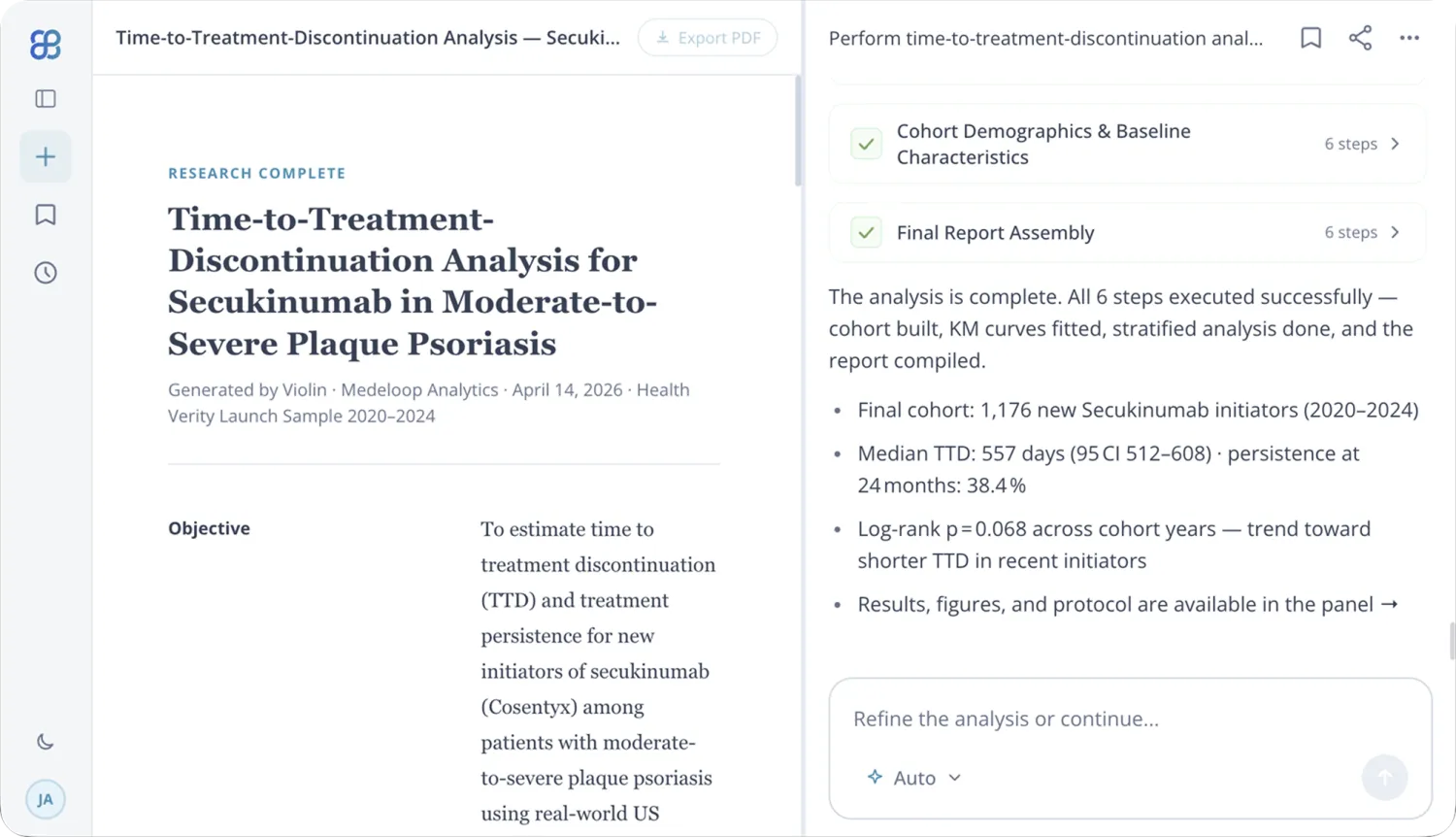
Each study produces a defined patient cohort, the full query execution log, statistical outputs (Kaplan-Meier curves, regression tables, descriptive statistics), data visualizations, and a manuscript-ready narrative report. Every output is traceable, reviewable, and reproducible, designed to hold up to peer review, IRB review, or board presentation.
How long does it take to run a study?
Most analyses complete in minutes. Complex multi-step studies with large cohorts may take longer depending on your data infrastructure. The agentic pipeline runs all steps automatically. You review the plan, approve it, and the system handles execution.
Is Medeloop Analytics the same as EvidenceKit?
Analytics is the platform. It runs on your own data. EvidenceKit pairs the Analytics platform with the licensed HealthVerity all-payer claims dataset in a single subscription. If you don't have your own institutional data yet, EvidenceKit is the fastest way to start.